A free basic pattern for a simple scarf suitable for handspun or any bulky weight yarn.
Yarn:
100 yards bulky weight yarn
Materials:
-Size 11 needles, or size to get gauge
-Tapestry needle to weave in ends
Gauge:
3 stiches per inch
Finished Size:
4.5 inches wide/40 inches long after blocking
Level:
Beginner- knit, purl
Notes:
Make the scarf longer by using more yarn- 150 yards bulky yarn would be 60 inches long, 200 yards would be 80 inches long.
This scarf can be knit in a solid, striped, or multi colored yarn. The pattern shows up best with yarns that have some stitch definition.
Click here to get the PDF pattern for Blocky.
You can also download a copy from Ravelry here: download now
Pattern is 1 page with full color pictures, please feel free to share with your friends, use in your shop, etc. You make direct people to this page (http://blog.midnightskyfibers.com/2011/01/new-free-pattern-blocky.html) or share the pattern with them directly printed out or as a PDF. When sharing with others please keep the pattern with the copyright and notice intact.
Some ideas for sharing:
-Project idea for handspun yarn (link in etsy or send along a copy with your handspun yarn)
-A free yarn pattern in your newsletter
-Print out as a freebie in your shop
Like this pattern? Thanks for sharing it! If you like the pattern it would be awesome if you would take a minute to share it with your friends on twitter and facebook!
Need short links? http://tinyurl.com/freeknitpatternblocky and http://tinyurl.com/freeblocky link directly to the pattern. http://tinyurl.com/knitscarf is another short link to this blog post.
If you like this pattern you might also like: Circle Vest Knitting Pattern (my most popular pattern for sale to date!) and the Space Hats Pattern Collection.
Showing posts with label patterns. Show all posts
Yarnies: I need Your Help
Yarnies (and small shops too), I need your help, and want to help you in the process! Midnightsky Fibers sells super awesome knitting patterns for handspun yarns and small amounts of handpainted yarns. They are designed to be quick to knit, not take much yarn, and are PDF downloads.
But here's the thing. I can't make enough yarn to REALLY make TONS of awesome kits, nor do I want to. And the patterns work well for many different types of handspun- thick and thin, coils, novelty, art, singles, plys, small skeins of handpaints...That's where you come in. Help me sell more patterns so you can sell more yarn!
So here's how you can help:
If you make handspun or handpainted yarn, you can sell Midnightsky Fibers patterns. You can recommend them with yarns, make kits with them, teach classes, or just sell the patterns.
There are two ways to sell Midnightsky Fibers patterns:
1. Wholesale- if you are a small shop and want to be able to print out the patterns to sell, have them in your online shop (etsy, anywhere you need to have an inventory), or include them in a kit, you need a wholesale account.
2. Affiliate- fancy way of saying you refer people to Midnightsky Fibers patterns and get a portion of the sale for each one that you sell. But this is different. You can link to to the patterns as a recommendation (the usual way affiliate works, for places like twitter, etsy, etc) OR you can add the pattern to your shop or blog.
Here is what I am doing to help:
First, Wholesale: There are no pattern minimum purchases. Patterns are instant downloads- no waiting for patterns to arrive, you can keep them digital and sell the PDFs, or you can print them out. Wholesale accounts get their own newsletter about product updates.
Affiliate: Unlike most affiliate programs where you get less than ten percent, you get 40% of the pattern sale. It's a really easy way to boost sales of handspun yarn too- people like to know what they can make with handspun yarn. Affiliates also have their own newsletter (sign up for the newsletter and I will update you as an affiliate after you sign up), so you will get shop updates of new products and ideas for how to sell the patterns.
There is an entire section about being an affiliate for Midnightsky Fibers patterns. It includes ways to list the patterns, tutorials to walk you through becoming an affiliate, and more helpful information, like pattern recommendations by yardage, so it is easy to figure out what patterns go with what yarn you are making.
Here's how to do it:
Wholesale: Info for wholesale accounts.
Affiliate: Read the affiliate page then sign up at Ejunkie.
Why? Not all yarnies are pattern designers, and even if they are, not everyone wants to or has the time to spend designing patterns for handspun. There is huge competition for selling handspun yarns, so now just making and listing handspun (or even handpainted) yarns isn't enough. While patterns do not generate a huge income for most stores, they are a low cost way to add to sales, and pattern recommendations help encourage people to buy yarn!
But here's the thing. I can't make enough yarn to REALLY make TONS of awesome kits, nor do I want to. And the patterns work well for many different types of handspun- thick and thin, coils, novelty, art, singles, plys, small skeins of handpaints...That's where you come in. Help me sell more patterns so you can sell more yarn!
So here's how you can help:
If you make handspun or handpainted yarn, you can sell Midnightsky Fibers patterns. You can recommend them with yarns, make kits with them, teach classes, or just sell the patterns.
There are two ways to sell Midnightsky Fibers patterns:
1. Wholesale- if you are a small shop and want to be able to print out the patterns to sell, have them in your online shop (etsy, anywhere you need to have an inventory), or include them in a kit, you need a wholesale account.
2. Affiliate- fancy way of saying you refer people to Midnightsky Fibers patterns and get a portion of the sale for each one that you sell. But this is different. You can link to to the patterns as a recommendation (the usual way affiliate works, for places like twitter, etsy, etc) OR you can add the pattern to your shop or blog.
Here is what I am doing to help:
First, Wholesale: There are no pattern minimum purchases. Patterns are instant downloads- no waiting for patterns to arrive, you can keep them digital and sell the PDFs, or you can print them out. Wholesale accounts get their own newsletter about product updates.
Affiliate: Unlike most affiliate programs where you get less than ten percent, you get 40% of the pattern sale. It's a really easy way to boost sales of handspun yarn too- people like to know what they can make with handspun yarn. Affiliates also have their own newsletter (sign up for the newsletter and I will update you as an affiliate after you sign up), so you will get shop updates of new products and ideas for how to sell the patterns.
There is an entire section about being an affiliate for Midnightsky Fibers patterns. It includes ways to list the patterns, tutorials to walk you through becoming an affiliate, and more helpful information, like pattern recommendations by yardage, so it is easy to figure out what patterns go with what yarn you are making.
Here's how to do it:
Wholesale: Info for wholesale accounts.
Affiliate: Read the affiliate page then sign up at Ejunkie.
Why? Not all yarnies are pattern designers, and even if they are, not everyone wants to or has the time to spend designing patterns for handspun. There is huge competition for selling handspun yarns, so now just making and listing handspun (or even handpainted) yarns isn't enough. While patterns do not generate a huge income for most stores, they are a low cost way to add to sales, and pattern recommendations help encourage people to buy yarn!
Making Ties for Hats and Closures (knitting)

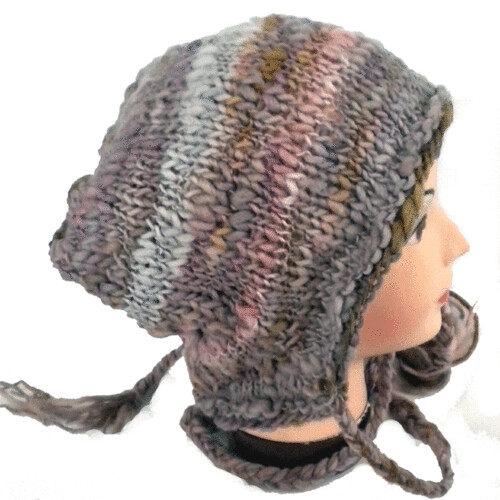
(The Rocket Hat, available as a Kit or Hat Pattern)
My favorite tie for hats is hands down almost always braid, usually 3 or 4 strands. Braids have more texture but don't stretch out as much. Other projects like ties for sweaters might require a more sophisticated closure, such as garter stitch ties used to hold the front of a sweater closed in place of buttons.
To make braids for hats:
Take a bundle of yarn (I use 6 strands or 9 strands depending on the thickness of yarn) twice the length you want the ties to be and pull through the edge of the hat at the edge below the decreases. Divide in to 3 strands and braid tightly. Tie with a knot and trim ends neatly.
Crochet chain Ties:
Done with simply a chain of crochet or with one row of single crochet to make it thicker. Nice and fast, but has a tendency to curl.
Cast on/cast off chain-
2 or 3 stitches are picked up along the edge where you want the tie to be, then use a cable cast to add stitches until desired length, turn and bind off (a stretchy bind off is helpful here). This has the advantage of having both yarn ends to be woven in at the top of the hat.
Alternately, use a long tail cast on to cast on desired number of stitches, pick up several edge stitches, then bind off.

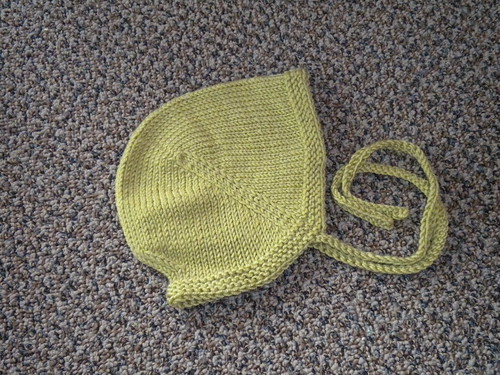
(A Hello Yarn Baby Bonnet I made in Debbie Bliss Baby Cashmerino)
Icord
Icord is probably the most elegant solution, especially for items with an icord border- Elizabeth Zimmerman is great for this. Icord ties can be made over 4 or 5 stitches to make them thicker. The downside of icord is that it tends to be slippery, so bows and knots will not always stay put and sometimes tighten quite tightly, making it hard to undo.
Garter stitch
Garter stitch's biggest problem is that it stretches out. Easily worked, the idea is the same as the cast on/bind off method, but work several rows back and forth instead, picking up stitches at the edge of the hat every other row as you go along. Especially nice if you can knit them in (by casting them on in pattern) while working the garment.
Attaching the chain
Chains are best attached near the back of the work, with stitches picked up the usual way. When looping yarns through from braids or only creating a chain etc it is best to make sure you have gone through several strands of the main object's yarn- preferably two stitches side by side or something similar. This makes it harder for the ties to stretch the edge of a hat out by pulling on one strand too hard.
How long to make ties
I usually make ties at least as long as the hat, but usually twice as long if they are ties I want to be able to wrap around or tie in a bow. For closures to sweaters and other objects I usually make ties 3-5 inches, depending on how thick they are.
Subscribe to:
Posts (Atom)